

Master cherry I would like to carve like this Japanese carver named Kento. I notice asian carvers have a different style of carving, they can go really low on both edges, almost touching the snow with their whole body but I can’t out my finger on how they are able to do so. Kento seems to achieve high edge angle by extending the front leg on heel turns but I could be wrong. Would you be able to please take a look and provide some insight on his technique? Link:
thanks!!

I don’t know the intricacies of Korean & Japanese techniques, but they don’t seem to move their hips forward as much. The back knee always seems to be bent, transitioning over the tail, and then using their chest to get their centre of mass forward.
Here’s a series that might be helpful:
Big White, BC, Canada

@holkn I think our styles are almost identical! I thought tjis was video of me until I noticed the red pants. I don't have red pants...
Joking. This video is an excellent example of a very talented Asian style rider. Of course, I'm not doing any of those reverts and jumps so I looked most closely at the video section staring at 1:20 where there's a few linked turns of pure directional carving.
The biggest difference that jumps out to me is the timing of the compression and extension. (This movement has two components; the knees and the bowing of the upper body over the nose of the board. ) Look at his transitions: he'll suck up the knees into his body and quickly flip the board to the other edge. So at the moment of edge transition, when he's unweighting, his knees are bent at their maximum, we call this "down unweighting" (even though he may be jumping). Then, in the apex of his turn, he's fully extended through the legs.
In my turns (not always and exclusively, but generally), my legs are straight (maximum extension) at the transition ("up-unweighting") and then bent at the apex. It's kind of opposite. Classic Euro-carving is a down-unweighted turn, pencil line carves are up-unweighted turns.
There are many other smaller differences too. For example, Kento's movements are much more exaggerated than my own. He throws his weight forward on initiation and way back just before the transition. I do this too, but far less. He also compresses more (through the knees and the bowing) whereas I tend to minimize my movements to only what's required for a smooth turn.
Another difference is the board. His is narrower and way softer with a smaller sidecut radius. made specifically for this style of riding with the jumps and reverts and quick edge changes. Mine are bigger and a lot stiffer, made to hold an edge at higher speeds and carve wider radius, faster turns. Look at how his board chatters through almost every turn. If my board does that I consider it a mistake, a bad turn. I also close my turns more, achieving 180 degrees on almost all of them while Kento is making quicker, smaller radius turns, transitioning after only 170 degrees or less. His board is designed for this.
Kento also plays with the counter rotation in the upper body, this is characteristic of the Asian style. The rumour is that this was borne out of an historical accident in that the previous generation of Japanese carvers were taught by North American racers, and these old school riders influenced the current generation and their style. But those racers were teaching up-unweighted turns for sure, style has progressed a lot in 25 years.
I presume you asked @holkn because you want to emulate his style and you're wondering what to change from my instructional videos? Do everything pretty much the same except the transitions. Suck up your knees as you change edges and then push through the apex of each turn. This kind of turn is also better suited to production carving boards than pencil line carves though both are possible on production boards (to a limited extent). The down un-weighting will slow you down a lot and, with practice, leave you lying on the snow through your turns which is, I expect, where you want to be. For me carving is more about creating high g-forces and leaving the perfect track, but Kento has excellent style and I can absolutely see why you might want to ride like him.
Good luck, send video!
(You see now why I didn't want to write all this in the YouTube comment section? Thanks for posting here.)
I'm just slaying...
Wow thanks for the very detailed analysis!! Appreciate you taking the time to respond to my post! Yes now that you have mentioned it it does look like he’s doing down unweighted turns. I have been doing up-unweighted for years, I assume for down-unweighted you “stand up” on your board through the apex of the turn?
I assume for down-unweighted you “stand up” on your board through the apex of the turn?
Not so much "stand up" as "push out" through the apex. Give it a try!
I'm just slaying...
I guess it is a bit like the push-pull technique:
https://www.extremecarving.com/tech/excarving.html
But rather than relying on inclination, the Asian style uses angulation.
Big White, BC, Canada
But rather than relying on inclination, the Asian style uses angulation.
For the uninitiated, I think he means inclination of the body towards the snow versus angulation of the board away from flat on the snow.
The Asians seem to be in much smaller sidecuts than the extreme carvers.
This is a great example of Russian Extreme Carving, @bfreeap (on YouTube) is a friend of mine. His sidecuts are in the range of 20m. The down unweighting is much more subtle but it's there. So is the inclination. He is so fast. We tried to get video together but I'm making twice as many turns as him and I can't keep up. (I was riding a 171 15m sidecut that day (Park City last month), he rode a 185 20m.)
I'm just slaying...

The Asians simply have a smooth style.
I've been following them for a few years now.
And also all the posi/posi.
Anyone who takes a snowboard course here in Europe or wants to become a snowboard instructor. Or even study. The Duckstance attitude is a prerequisite. When I read that, I rejected it again. I had the idea of becoming a snowboard instructor in my spare time. I learned to snowboard with hard boots and posi/posi. Unfortunately I can't remember which angles they were. That was in 1992. I've never ridden in Duckstance, for whatever reason.
If you do a snowboard course in Asia in particular, South Korea, Japan, I think also China, you learn in posi/posi.
They also do competitions, something like the banked slalom, only as a carving variant. Who is better at carving style.
Why are there so many different approaches? The western style is so contaminated with park and big air, it's never been my taste. Showing tricks you've practiced on a few square meters.
That has alienated the meaning of snowboarding.
Snowboarding is all about. You, the board, the mountain. In the end, a unity is created and this results in flow. That's my philosophy.
I have included my playlist here.
Quite an interesting rider, follow his progress on the channel.
A Japanese snowboard instructor who also shows dry training.
Quite a nice channel showing a wide variety of riders.
https://www.youtube.com/@ToyFilms
I think he means inclination of the body towards the snow versus angulation of the board away from flat on the snow.
People do tend to use these terms differently. Here's a clip from the CASI manual (I think this nomenclature is becoming more common place):
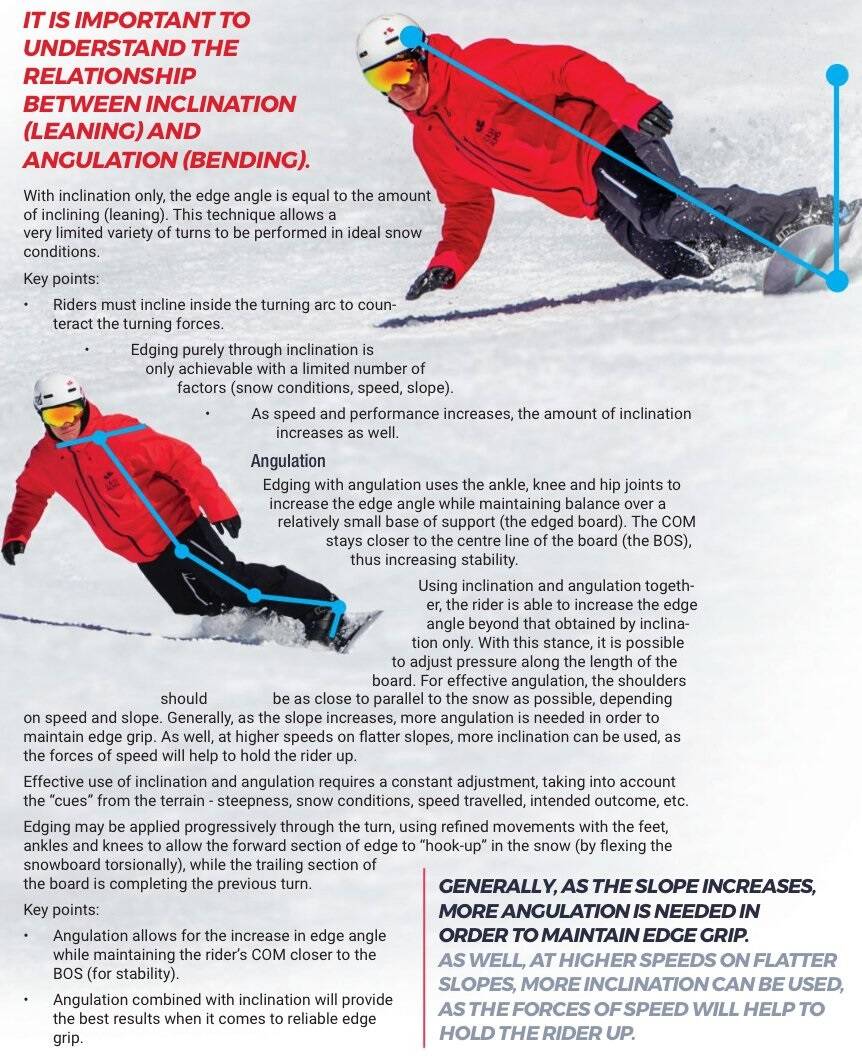
With inclination, the body is straight and the edge angle is simply equal to the amount of leaning.
Angulation uses the ankle, knee & hip to increase edge angle, while stacking your weight closer to the edge. The 'tray drill' acheives this, allowing much greater edge angles. (It seems like some people do conflate edge angle & body bending together as 'angulation').
Carving is generally pretty limited without angulation. Having said that, some of those Extreme Carvers are on such steep slopes that they can lay it out and essentially still be stacked over their edge. But even on more modest slopes, the G force they generate allows it. Watching people try this at modest speed on more modest slopes just looks ridiculous as they drag their arms and chatter all over the place.
Big White, BC, Canada

That’s the best explanation I’ve seen in a long time. I’ve been riding Japanese-style carving since 2017, and James did a great job explaining the mechanics of J-style carving, so I won’t repeat that here. I just want to add a few points.
In Asian carving, there are three main styles: JSBA Style, SAJ Style, and Korean Style. I’ll focus on the first two—SAJ and JSBA—and explain what they are and how they differ. For reference, Kento rides in the SAJ style, while Mizuki Taguchi is the textbook example of JSBA style. In Japan different brands even design boards specifically suited to each style of riding.
JSBA stands for the Japan Snowboard Association, and SAJ stands for the Ski Association of Japan. Within Japan’s snowboarding community, these two organizations are often seen as being almost entirely at odds—with differences that extend from their philosophy of snowboarding and its culture to the fine points of technique.
What fascinates me is this: how can the same group of people—many Japanese riders actually hold both SAJ and JSBA certifications—riding the same mountains and snow, produce such sharp divisions? To understand that, we have to start with their origins.
As a latecomer to the world of skiing, snowboarding really took off in the 1970s and ’80s. Before that, alpine skiing dominated mountains worldwide. In the late 1980s, the SAJ created a snowboard division to formally bring snowboarding under its umbrella. But the sport’s young, rebellious spirit clashed with the traditional ski establishment. In 1989, a group of riders broke away to found JSBA—the Japan Snowboard Association.
Initially, the two organizations weren’t that different. They co-published manuals, shared technical standards, and jointly ran badge tests (skill certification exams). But their fundamentally different visions of snowboarding soon set them on diverging paths.
The split became official in 1998, at the Nagano Winter Olympics—a landmark year for Japan, which won five gold medals, and for snowboarding, which made its Olympic debut. The IOC’s decision to designate FIS as snowboarding’s governing body triggered strong opposition from ISF, which was aligned with JSBA. But with the ISF underfunded and unable to compete in the politics of the IOC, JSBA had no choice but to accept FIS’s authority. From then on, SAJ (aligned with FIS) and JSBA (aligned with ISF) severed ties completely. To this day, only SAJ professionals can represent Japan at the Olympics, while JSBA insists that the Snowboard World Cup truly represents the highest level of the sport. The two organizations occasionally still trade barbs over their differences.
After Nagano, both SAJ and JSBA revamped their technical ranking systems. Broadly speaking, they follow similar structures, progressing from badge tests → instructor levels → examiner levels. Unlike many countries where you can go straight into instructor training, in Japan you must first pass the badge tests to qualify.
Both systems have five badge-test levels, with Level 5 being entry-level and Level 1 the highest. Level 5 basically means you can link smooth edge-to-edge turns—most riders can pass it easily. I’ve asked several Japanese coaches why the entry bar is so low, and they all said the same thing: they want to encourage participation and promote a correct understanding of snowboarding. The intention is admirable, though it also makes the Level-5 exam largely symbolic. Fortunately, riders confident in their skills can skip directly to Level 2. From there on, however, you must pass each level sequentially—no skipping (except in rare cases for elite riders who podium at major competitions).
Once you pass Level 1, you move into the instructor track. In SAJ, the hierarchy goes Associate Instructor → Instructor; in JSBA, it’s Instructor C → B → A. Each level authorizes different teaching contexts and venues. Since 2016, JSBA has added a new, independent “Tech Test” track with levels Tech 3 → 2 → 1, covering specialized terrain and riding methods. As a result, JSBA’s system now encompasses nearly every modern snowboarding style. The granularity of these divisions feels, in a way, uniquely Japanese.
Up through Level 3, the technical requirements of SAJ and JSBA are quite similar: smooth edge transitions, consistent carving lines, and proper edge control. But from Level 2 and above, their philosophies diverge sharply.
JSBA increasingly emphasizes form, while SAJ focuses on quality.
In JSBA training, coaches often repeat the concept of the “designated movement.” This refers to a required up-and-down body motion throughout the turn: pressuring the board during the body of the turn and unweighting—standing up—during the edge change to release pressure. Regardless of your line, terrain, or style, if this sequence is missing during an exam, points will be deducted. Seasoned riders will recognize this as a type of cross-over movement. While similar, JSBA’s version often lacks refined edge control; as long as you execute the crouch-then-stand motion, you can usually pass. This is precisely what critics of JSBA point to—a tendency to prioritize visible form over subtle feel.
SAJ, on the other hand, puts almost all its emphasis on turn quality—how the board moves through the snow rather than how the body moves. It values freedom of posture, precise edge angles, and refined board control. This stems from SAJ’s philosophy that skiing and snowboarding share the same essence: regardless of whether you’re on one plank or two, what matters is how you move the board(s) across the snow.
These differences have created an interesting outcome. Riders trained under JSBA tend to look stylistically similar, while SAJ riders vary widely. Some develop distinctive personal styles and even found their own “schools,” like Kazunori Hirama. Others move in quirky, expressive ways that add color to the slopes.
Korean-style carving was developed by Shim Hoon, a student of Kazunori Hirama. If you watch both of their riding you’ll immediately recognize the similarities—clear evidence of that shared lineage.
Focus on their upper body movement and their Knee when watching the video, you will see the similarity and differences.
SAJ Style:
,
Korean Style:
JSBA Style:
,
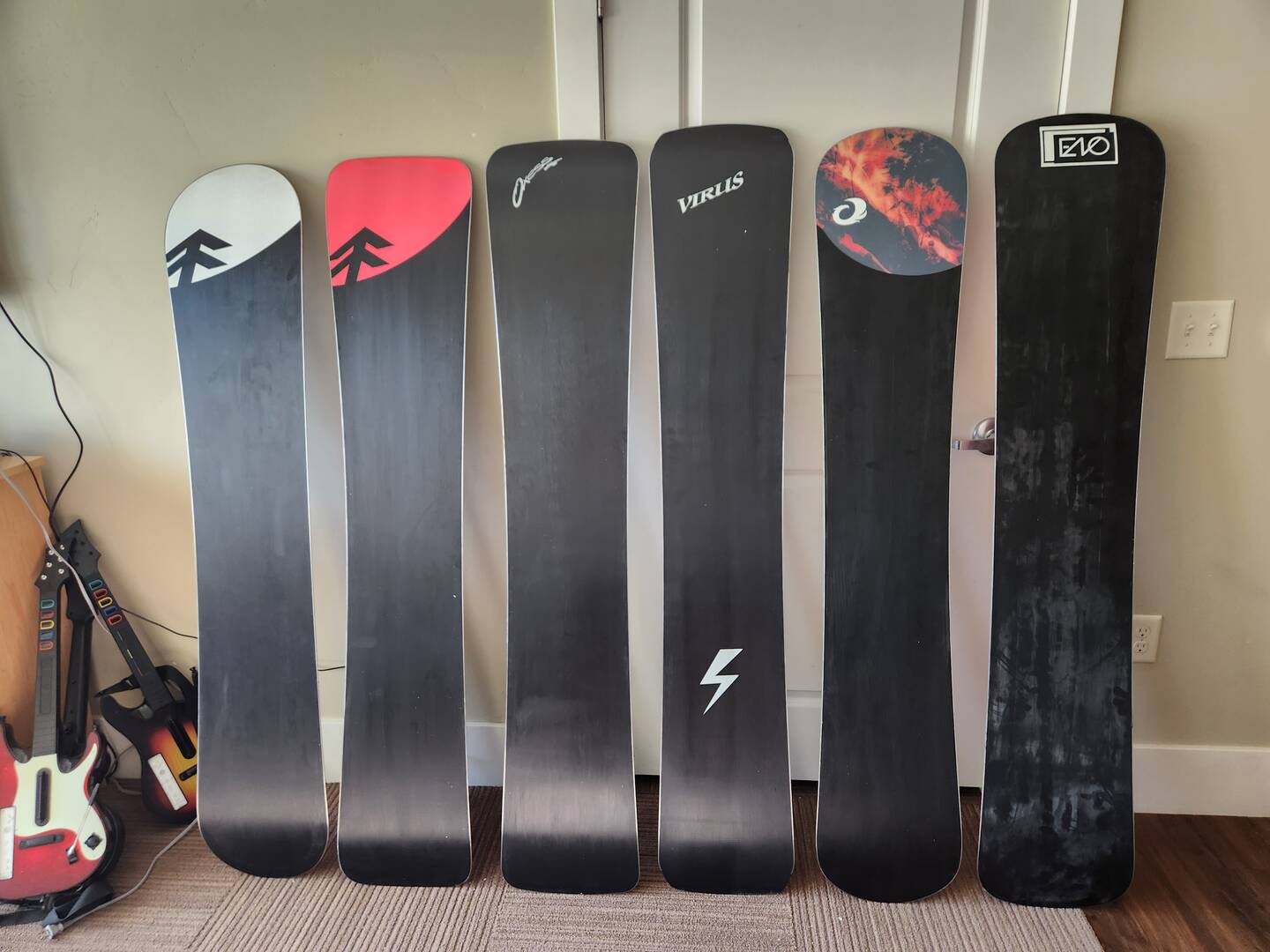
Over the years, I’ve owned a lot of Asian brand boards Gray, ENO, and Ogasaka—as well as several European ones like Oxess, F2, Kessler and Frank's Virus. I’ve also owned a Mark's Thirst and tried a few Bruce's Coiler in the past, though I’ve never had the chance to ride a JJA. Each region produces carving board with distinct characteristics I won’t go into that here, but if you’re curious, I’d be happy to answer any questions.
Wow @pigbrogg! Thanks for the history lesson! Fascinating.
Do continue please, I am very curious about how you found the boards differ across regions. Most of my boards have been North American made, Coilers, JJAs, Exegis and Thirsts. I've ridden a lot of other boards of course but I have never owned more than one carving specific board from any overseas brand.
The JJA C4 or Big Snowboards G4 is somewhat similar to the Coiler Contra. Not so much in its shape or design but in the feel of the turns they produce. If your Coilers were pre-contra era then it would be a whole new world for you. There's a reason we wanted to emulate the Contra...
I'm just slaying...
@pigbrogg Thanks SOOOOO much for that! I’ve always been so confused when people talk of these styles… and given the affiliated organizations, I would have thought the SAJ would have a more strict technique. It’s very interesting that there’s more variation in style with SAJ, and that a substyle led to K-carving.
To me, the JSBA appears to be more North American influenced, while some aspects of SAJ seem to be more surf inspired (with mostly tail engagement).
Big White, BC, Canada
Let me be crystal clear right from the start — feeling is subjective. I’ll try to be as objective as I can, but there’s no absolute truth here. What I’m sharing is my experience, not yours. We all ride differently, at different levels, and with our own styles — and that’s what makes snowboarding so personal and fun.
For a bit of background, I grew up on soft boots, though I’ve spent plenty of time on hard boots and even Skwal setups. Over the years, I’d call myself an expert rider, and that’s the lens through which I see and feel different boards. Every snowboard brand seems to have its own design philosophy, and when you start comparing Japanese, North American, and European boards, the differences become obvious — sometimes shockingly so.
Let’s start with Japan. Most Japanese boards are built around agility and sensitivity. Even the smallest shift in your body can change how the board reacts. Most of them run narrow waists, usually under 260 mm, and some even dip below 250. That narrow waist gives you fast edge transitions — they just dance from edge to edge. Material-wise, Japanese boards tend to keep it simple: wood core and fiber laminates. You won’t often find Titanal or rubber dampening like on North American or European boards. And that’s by design. A super damp board might absorb chatter, but it also kills board feel. Japanese designers want you to feel every movement — to know what’s happening under your feet. If the board does all the work for you, you can’t make those micro-adjustments that separate good riding from great riding. Now, when you look deeper, JSBA and SAJ styles. Brands like Ogasaka and Gray are heavily influenced by JSBA. In JSBA, riders bend their knees at the apex of the turn — it’s all about completing the carve smoothly and carrying speed. These boards are built to guide you out of the turn naturally, instead of forcing you to muscle the board through it. On the other hand, BC Stream designs boards more for the SAJ style. Here, you extend your knees at the apex to exit the turn earlier — kind of like modern GS technique. Their boards have very little tail taper, so as soon as you push through the apex, the board wants to start the exit sequence immediately. These are made for riders who like to exit turns fast, not stay in them forever. A few Japanese boards do use Titanal or rubber, like the Gray Type R, Type X, Moss Legit, and BC Stream RXti, but to me, those lose a bit of what makes Japanese boards special. They gain weight, lose some rebound, and just feel less lively overall.
I think North American builders approach carving more like the JSBA philosophy — chasing that complete, pencil-line carve that flows naturally from one turn to the next. The goal is to let the board guide you, not fight against it. Take the Coiler Contra, for example. That board basically carves itself. Hold your posture, nail your edge transitions, and it does the rest. You don’t need to throw your upper body around like those Japanese riders — it’s just smooth and effortless. Honestly, I’d say it’s one of the easiest boards to ride out there. Now, I’ve got to talk about Bruce. His boards are crazy damp — smoother than anything, though maybe a bit too damp for my taste since I prefer more feedback. But wow, they are buttery smooth. I still regret not getting a custom Contra when I had the chance. I owned a custom Thirst CC+, and I’d say it sits right between a Coiler and a Japanese board. It’s damp, but not dead. It’s sensitive, but not twitchy. I ride in a style similar to Kento, and the Thirst handles it beautifully — super responsive when I push it hard, but mellow enough for easy morning runs. It guides me out of turns like a Coiler but demands a lot a lot more effort when the snow isn’t perfect.
Now, let’s talk Europe. I’ve owned quite a few European boards — F2 Eliminator World Cup Titanal, Oxess CX, Kessler X Carve, Virus X Carve, and a few hard-boot Oxess. Here’s my honest take: Europeans haven’t quite figured out soft-boot carving boards yet. The F2 Eliminator World Cup is a BX race board, so let’s skip that. The Kessler X Carve feels like their softened-up BX race board — powerful, precise, and slightly more forgiving. It’s got a hammerhead nose, and it rides well if you’re an expert, but it still demands lot of energy, It’s not a chill cruiser.
Then there’s Oxess. Marcel, the guy behind Oxess, knows what he’s doing. His boards are loaded — Titanal layers, P-Tex topsheets, rubber dampening. I owned their BX board, and later, the CX, which is a totally different animal. The CX is stable as hell, grips ice like it’s glued to it, and you can feel the World Cup engineering in every carve. But it’s not an easy ride. It’s built for riders with power, not precision. Unlike the Coiler Contra, which rides smoothly with minimal effort, the Oxess CX demands you to dump energy into it. Do that, and it’ll reward you with rock-solid performance in any condition. Don’t, and it’ll ride you instead. Finally, there’s Virus, I had the X Carve and tried their GS setup with an Allflex plate, the same rig Benjamin Karl used to win the 2022 Olympics. The X Carve isn’t Titanal-based; it uses Zylon fiber, and it’s hands down the most responsive board I’ve ever ridden. It’s feather-light, insanely responsive, and feels like an extension of your body. Every input translates instantly. The flip side? It’s unstable and unforgiving. When the snow gets rough, it chatters like crazy, and even small mistakes can bite you hard. But if you’re precise — and I mean laser-precise — it rewards you with explosive energy and rebound out of every turn. If you love drift-style carving, this thing will blow your mind.
On the other hand, BC Stream designs boards more for the SAJ style. Here, you extend your knees at the apex to exit the turn earlier — kind of like modern GS technique. Their boards have very little tail taper, so as soon as you push through the apex, the board wants to start the exit sequence immediately. These are made for riders who like to exit turns fast, not stay in them forever.
This is interesting, and not something I had really thought about. Is it because the lack of taper increases the tail pressure earlier and wants to release?
Big White, BC, Canada
Also, what’s drift-style carving?
Big White, BC, Canada
