

Hi James,
I have a question about butterfly risers and their positioning. I saw your short video this morning about the SG copies they made.
If I understood your explanation correctly, the part under the heel should be positioned slightly further forward, more aligned with the front of the foot, so that the pressure is better distributed between the front and back of the foot when turning… Is that right?
Another thing,
why is the SG positioning less effective? I would have naturally positioned them that way too. In my mind, they follow the direction of the binding. I should mention that I've never used this type of riser before, so I'm starting from scratch with this product.
Thanks for sharing your experience.
Pat.... AKA "PAT WHO"

like explained in the video the idea with the riser is to more efficiently transfer power/leverage to the edge of the board. Considering the geometry of the riser (they’re hollow) (and also bindings) the force is delivered to the perimeter.
And like explained in the video or in one of James’ many carving technique videos you’re supposed to pressure the heel side edge closer to the nose of your board compared to the heel of your binding, about at the same ”height” as your toes. So offsetting the heel piece towards your nose simply helps with leverage.
Anyone can correct me if I’ve understood this wrong, I kind of wanted to test my knowledge here 😉
Dreaming about soft snow

the part under the heel should be positioned slightly further forward, more aligned with the front of the foot
Yeah. What he said ( @superfelix ).
On a heelside turn we pressure the board just in front of the front heel, especially at initiation. Production boards are often too soft here to hold the required edge pressure for a high speed, high edge angle turn. So sliding this wing up towards the nose helps stiffen the board at that point, distributing and transferring the forces directly to the edge.
On a toeside turn the weight is further back, closer to the back toes. And just after the apex of a turn when the edge pressure is highest I'm often pressuring the small toe area on the back foot so that's where I want the wing, to distribute this pressure and reinforce the board's flex.
This is new wave ASYM tech. The old school ASYM had the sidecuts shifted in the wrong direction. I guess they assumed that since the toes were closer to the nose of the board than the heels, the sidecuts should be offset to compensate. But despite the position of the toes and heels in our posi-posi stances, our weight is actually more forward on heelside than on toeside and the sidecuts should be offset to accommodate the actual area of the board that receives the most pressure on each side.
I'm working with Jasey on this now, more ASYM protos are coming soon. And it's not just an offset sidecut, it's a different variable sidecut, different materials and different flex on each side. New protos are 175cm x 300mm wide waists. One is for me, one is sold, one (regular, left foot forward) is available for purchase.
By all means though, play with this riser positioning and report back. The best positioning I found has the front set with the heel wing two notches further forward than the toe wing, and the back foot one notch forward or parallel. There are some limitations also from the bindings, since I want at least almost all of the baseplate positioned under the risers. (I'll hang a corner off now and again, unless I'm riding Skate-Tech.) Jasey's original one piece butterfly riser had the toe and heel parallel, with the heelside slightly larger than the toeside. I think this might have been a compromise though, so they could be used regular or goofy. Different boards require different amounts of the fore-aft motion, and different riding styles can exaggerate or quiet down this motion, so what works for me on my board may not be 100% optimal for someone else on their board, and so the adjustability is nice.
And for the record, SG did not copy my Butterfly Wing BX Riser. It was some dude in Turkey trying to save a few bucks by 3D printing his own. He mounted them on an SG, published an Instagram reel and SG added it to their story. Sigi reached out and politely asked me to correct the record. I deleted the reel and made the YouTube version Unlisted so the comments don't disappear and links I sent out would still work. This is the original, I will have to make another Butterfly Wing Install video later and retract my accusations:
https://youtube.com/shorts/wzIIA7h0XTU?feature=share
I'm just slaying...

James,
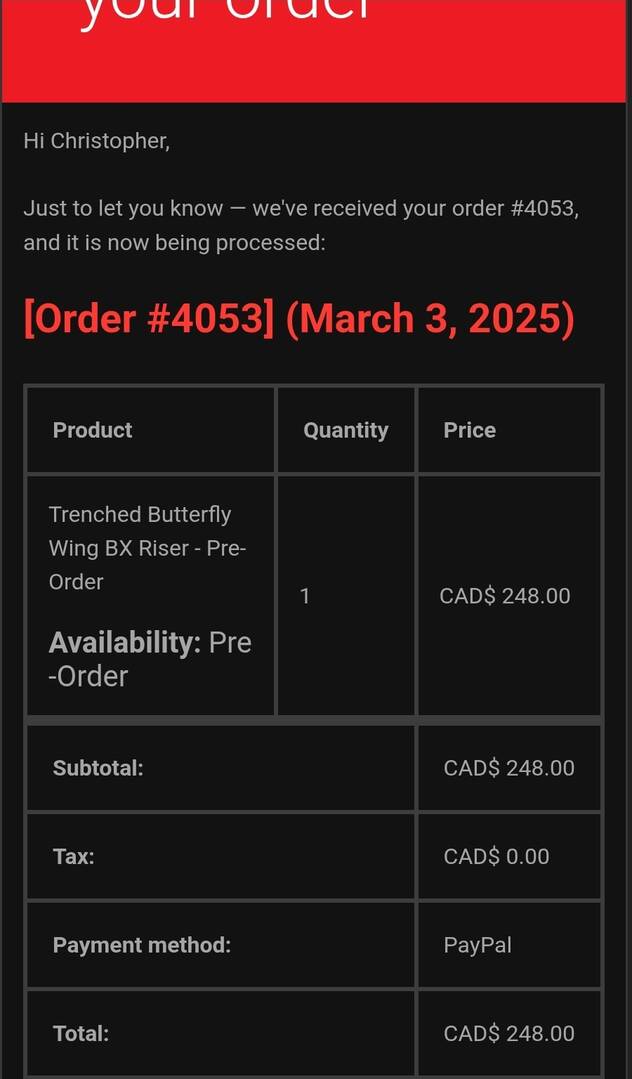
Order #4053, placed March 3, 2025, has not been fulfilled. I see others on here have received and tested their 2025 versions and are discussing your 2026 version.
I also emailed info@carversconnection.com with no response.
Please advise what's going on with this order.
Thanks.
Just picked up the new wings today, shipping Friday.
No one has got any of the 2026 Butterfly Wings yet. I did sell some old stock to Aussie's over the summer but the 2026 risers in the video above were just a test set. Until today that was the only set available.
Thanks for your patience. I see you pre-ordered these so will be a t-shirt, stiffeners and straps in there too for ya!
What size t-shirt do you wear?
James
I'm just slaying...
