

Hello all:
I hope everyone is having a fantastic summer. Curious what folks do off-season, especially for those who are no longer in their 30s and 40s, to get their legs ready for carving next season. It’s never too early to start! I used to be a competitive mountain biker, but for a while now, I have been playing more golf. Less wear and tear, but losing leg strength every year.
It seems body weight exercises might be better than nothing, but I’d guess squats with some weight, maybe difficult hiking, and maybe some yoga or Pilates, would be good. I really don’t know. I'd love to hear from others on this topic. It also seems like ankle and foot strength might be easily overlooked.
Thanks!
Dan

I’m 35…
But I’ve been doing constant tension squats with a ~16 kg dumbbell to failure, for 3-5 sets with plenty of rest between sets, like 10-30 minutes.
Just get down to thighs parallell with the floor, then drop 5 cm, up 10 cm, down to the bottom position. It’s an absolutely terrible exercise and makes you want to vomit. You can probably make it a bit more snowboard specific by not squatting as deep… but that lightens the load so the time under tension will increase and the time while you’re close to failure will be longer which will make it even more hellish of an exercise.
If you have access to a barbell I would suggest using that over a dumbbell for ergonomic reasons I can’t use a barbell because I’ve fucked up my elbow with tendinitis so I need to add weight by just holding it in one arm. Use maybe 15-30% of your one rep squat max to start with and aim for 30 second sets. It will feel light the first 20 seconds but the last 10 will be agony. I’m up to just shy of 2 minutes on the first set if I’m rested, but that’s with 10% of my 1RM.
My rationale is I need to build my strength endurance. I noticed last year that my added weight caused me to cramp up in my right quad near the knee especially. More when carving hard on skis than snowboarding because I’m not good enough at snowboarding yet.
I also try to increase dorsiflexion in my angles by stretching my calves and Achilles tendons, I noticed that as a limiting factor when snowboarding last winter too.
I should probably do some cardio too… but running is the worst… but it would solve the ankle and foot strength part since I only have barefoot-ish shoes.
Dreaming about soft snow

Despite being a little overweight it’s not my major muscle groups that I usually feel, it’s all those tendons & things that I don’t normally use. Hiking uneven terrain seems to help keep all those stabilizers for balance in check.
A longboard for carving gentle hills is great... and when pushing back up alternate between regular & goofy each run. Increasing stability over the front leg can really improve your switch riding, but probably balance in general. I say gentle hills because asphalt is WAY harder than snow and getting injured can be a real setback.
If you’ve got a pump track nearby, skating those is a real workout. I think those banked turns improved my snowboard carving as well, as I was getting my weight too far inside the turn and this became readily apparent here.
I haven’t done any mountain biking in over a decade but I am trying to do some trail riding this year, largely to get my cardio back (after having Covid last fall) and hopefully loose some more weight.
Exercise needs to be fun for me, preferably outdoors, or I just don’t do it. I’ve had to do a lot of physio for my shoulder rehab and I really hate the monotonous repetition.
(I’m 50)
I should also note that I’m stretching every day and do work on Dorsiflexion to keep my plantar fasciitis (and perhaps the osteoarthritis) at bay.
Big White, BC, Canada

It’s an absolutely terrible exercise and makes you want to vomit.
This I like a lot! When you stand all the way up and lock out your knees in a squat, that momentary rest actually allows the muscles to recover quite a bit, way too much in my opinion.
My rationale is I need to build my strength endurance.
This, I question a bit, even though this is the range that we're generally working when carving (about 45 seconds to 3 minute sets). Strength endurance (aka anaerobic endurance) is highly sport specific. In other words, this type of training doesn't carry over very well when the body position changes even a little bit. Trying to replicate snowboard carving indoors is not impossible and perhaps better than not; I have been known to do my squats in a 27/12 degree stance for example, but I will definitely not lock out my knees and keep those muscle fibers firing throughout the whole set without rest.
Strength endurance is also very quick to build and adapt to a sport, but progress will plateau after just a few weeks so it can tend to be overtrained. Professional athletes who employ training cycles will often come back to a few weeks of strength endurance every few months, focusing on other aspects of strength and endurance maybe 3/4 of the cycle (depending on the sport, the athlete's goals and general strengths and weaknesses).
The other aspects they might focus on in their cycle are hypertrophy (gaining muscle mass), power (maximum muscle fiber recruitment for 1-3 reps), and endurance (building the vascular system to increase blood flow for oxygen and glycogen delivery to working muscles), though not necessarily in that order. Each of these other elements are less specific to the sport or body position and will transfer better to snowboard carving than strength endurance trained off the snow.
A strategy that would allow a rider to maximize their performance during a season would focus on each of these elements. Growing muscle, and then training the new muscle fibers to short bursts of high power before the season starts will yield better results by Christmas (assuming one rides 15-20 days by then) than a heavy focus on strength endurance throughout the off season. Carving is the best training for carving, so think of off season training as getting your body ready to start the in-season training. Plan to be in top shape around mid January, not on opening day.
Some General Tips and Ideas for Off-Season Training:
1. Focus on functional strength over body building routines. This means, for example, changing up your stance and grip with each set. Body builders want to do precisely the same motion throughout their sets (and over many weeks) to make those particular muscles pop. This strategy will help you look good at the beach, but it can also lead to injury through muscle imbalances. We need good stabilizers and strength in a variety of positions.
For pure strength training, favour compound exercises like calisthenics, squats and pullups that work multiple muscle groups at the same time over, for example, leg press machines that focus on one muscle group and one range of motion without recruiting the stabilizers. And for the same reason, use hanging rings over fixed bars for things like leg lifts, pullups and dips. (Yes, I recommend pullups and dips, even though these might be considered upper body exercises they are fantastic compound exercises that work the core - see below.)
2. Focus on the core. There's no doubt that strong legs are required for carving, but the core is at least equally essential. It's the core strength that allows your legs to do what they need to do. Legs of steel on a jello core will just get you tossed around. Strong legs on a strong core enables you to absorb bumps and rough terrain and keep carving smoothly. For core training, calisthenics is probably the best.
Carving is a somewhat isometric activity, especially through a single turn when the edge pressure is at its highest and you're just trying to resist the forces and find some patience in your body position, so training the core in isometric positions is recommended. That means planks over sit-ups, for example. And when you do concentric exercises (like hanging leg lifts) hold the top position and squeeze for an extra second. And remember to mix it up (as in 1 above), including the lower back and obliques in your core routine to maintain balance and achieve functional strength and a durable body. One arm farmer's carry over the cable axe chop, for example.
3. Any kind of cardio that keeps the legs moving and the heart pumping for 20-30 minutes continuously will have a huge benefit to your ability to carve longer without resting and to recover faster. During the season most of our training is actual carving and you're not gonna get 20 continuous minutes of aerobic capacity training. So train this in the off season. Mountain biking, pushing a longboard, uphill hiking, running, or stair climbing are all good, so long as you get that heart rate up and keep it there for 20-30 minutes minimum.
4. Don't neglect power/ recruitment training. I trained for rock climbing pretty full time for about a decade and this sport requires a lot of power, which is the ability to contract a high percentage of muscle fibers at the same time. I credit this ability a lot for my carving progression. 1-3 max reps to failure is the range for power training, though this intensity may not be ideal for the ageing carver, especially those who haven't done much recruitment training before.
Plyometrics and eccentrics are also excellent for training recruitment at a slightly lower intensity; this is where you contract a muscle while that same muscle is lengthening. Jumping down off a box and then immediately springing back up onto a second box is an example of plyometric training (it's the catching part that's crucial, when you land and you're contracting the leg muscles but the knees are still bending to absorb the impact). I do squats with two dumbbells as another example: I won't rise up enough to lock out my knees but I will jump a bit or at least unweight my feet at the top of the range and also kind of release the dumbbells a bit and catch them again on my back down, making the common squat into a plyometric exercise for an old man who doesn't want to get injured pushing his one rep max. (Don't overdo these, work them in from time to time along with or right after your hypertrophy phase. And don't do these at the end of your routine when your muscles might be fatigued. You're playing with fire when you train power, it's definitely an important part of a larger program but it can cause injury for sure so take it easy and only do these once in a while.)
5. Develop a recovery instinct. Unless you're a 22 year old athlete with world cup genetics, you will need rest... The idea behind strength training is to get your body to adapt to the stimuli and get stronger over time. Immediately after a workout you should be weaker, you actually get stronger on your rest days. You want to time the next workout to take full advantage of your body's natural adaptations. When you are fully recovered from a hard strength workout, you will be momentarily stronger than you were before the workout. It is at this moment that you want to work out again. Too early and you lose the benefit of the adaptations which are still in progress, too late and you're maybe back to your pre-workout strength already with no net benefit from that workout. As a rule of thumb, double the amount of time between the workout and the time you feel maximally sore in the trained muscles. If you're not seeing steady progress it's likely because you're not hitting the next workout at the right time.
Be flexible on your workout schedule to accommodate your body's need for recovery but be consistent too. If you went too hard and you're still sore after two or three days, consider an active rest day where you might do a shorter version of your strength routine with much lighter weights to encourage recovery, or focus on light cardio to get blood flowing though your sore muscles and speed up recovery, but don't lift heavy again until all the soreness is gone. This is self defeating.
Keep your goals in view and try to self-assess your strengths and weaknesses when you plan a session or a months long periodized cycle.
6. Off-season technique training. As suggested by @board-doctor above, skateboarding or other board sports can be excellent substitutes for actual snowboarding. Though the techniques aren't super close, this is a great opportunity to get more comfortable riding switch for example, and to build healthy ankles and feet. And if it's fun then it's self-motivating for those who might have trouble dragging their asses to a gym and those who hate running like @superfelix and me.
7. Periodized cycles. Since there are five months left until the season really kicks in, this is an excellent opportunity to approach your training with some forethought to get the most benefit from the time and effort you put in to training. A proper cycle (there's even time for two short cycles) will maximize your readiness when the lifts starts to spin.
Briefly summarized, a cycle will begin with high volume, low intensity work and end with high intensity low volume, with at least two weeks of rest between cycles. For example, you might start with a general fitness program which includes a lot of cardio and some light weight training (or even elastics if you have some lingering injuries) to get ready for weight lifting and calisthenics in the second phase. Work on your form here, this is important to prevent injury but hard to do when you're lifting heavy. Towards the middle of your cycle (phase two) the focus is more on hypertrophy and building muscle mass, increasing the number of fibers in the important muscle groups (legs and core) and maintaining balance in those muscles (hamstrings and lower back are chronically undertrained, for example). Taper the general fitness and aerobic endurance a bit at this stage, but do at least enough to maintain what you've built in the first phase. The third phase could be more focused on power and recruitment, shifting from the hypertrophy focus slowly and doing the same exercises with more weight for fewer reps. Still maintaining a couple of cardio workout per week, but more for recovery and maintenance at this phase. This is where you're pushing really hard with eccentrics, plyometrics, and power training. So you might only be training twice a week or every third day, versus the 5-6 sessions a week that you did in the first phase. The fourth phase would generally be the strength endurance phase, where you bring everything together and start to peak for your sport, but since strength endurance is so sport specific I wouldn't invest a lot of energy into this until you have access to snow. Training at either end of this range will probably yield more benefit than trying to replicate the demands and motions of actual carving for 1-3 minute sets. The final phase is rest, and it's crucial. Take a couple weeks off heavy training just before the season starts to make sure that you are fully recovered and in the best possible condition to have a long and enjoyable season without injury. You might feel like you're losing some of gains you worked so hard for in this final phase, but it's way better to take the rest before the season starts than be forced by injury to rest while you're missing some great days on snow. (I had to learn this lesson the hard way, more than once.)
That's probably way more than you were asking for @danielgrow but oh well, I'm procrastinating today.
I'm just slaying...
This, I question a bit, even though this is the range that we're generally working when carving (about 45 seconds to 3 minute sets). Strength endurance (aka anaerobic endurance) is highly sport specific
I agree about the strength endurance part. But I also don’t live anywhere near a proper hill so I wanted to experiment and see if it makes a difference if I train it as hard as I can for the relatively few days on snow that I get.
But the constant tension squats are also a decent way to train for hypertrophy. Most research seem to point to that getting as close to failure as possible is more important than the number of reps etc, and it’s easier mentally to get closer to failure with a somewhat lighter weight as it doesn’t get as scary to get that tired then. But I would prefer barbell squats if I could do them, and especially to be able to do more than one exercise...
I have zero experience training for a sport that requires muscle activation for longer than less than a second. From 10-25 I did the short sprint events and long jump, and lately I’ve done some Olympic weightlifting. I’m just going off of vibes and what I have available to me, which is a single dumbbell that I can make weigh 1-16 kg.
I should probably have made that more clear!
Jumping down off a box and then immediately springing back up onto a second box
I have an absurd amount of experience with plyometrics though!
Box jumps are in my opinion unnecessarily dangerous for the regular person as you risk hitting the box with your shins or feet as you get tired. I’ve heard some people jokingly call box jumps a hip flexor exercise because what’s important is to pull your knees to your ears rather than actually jumping, when it comes to jumping up on the tallest possible box. This is mostly because people tend to pick boxes that are too tall instead of focusing on the jump itself.
I prefer simple counter movement jumps done on the ground, especially if it’s your first time doing this style of training. Simply stand, jump, decelerate the landing down to a strong jumping position and immediately jump again. You can also do this purely with ankle flexion.
This allow you to tune how hard you jump compared to what forces you can decelerate without having to find a box of the perfect height. It also allows you to do a couple of reps without having to turn around or have a bunch of boxes. Basically, it’s a less intense exercise and therefore less injury prone. it’s still a very intense exercise if you are not used to jumping.
Dreaming about soft snow
I prefer simple counter movement jumps done on the ground, especially if it’s your first time doing this style of training. Simply stand, jump, decelerate the landing down to a strong jumping position and immediately jump again.
Yup, this one is great. This is probably my number one exercise for snowboard training, and as above, sometimes with dumbbells.
But the constant tension squats are also a decent way to train for hypertrophy. Most research seem to point to that getting as close to failure as possible is more important than the number of reps etc.
Probably also true. Most of my education in this area is based on literature that's 20 years old now, well out of date.
A basic fact that remains true though is that something is better than nothing. So whatever training protocols work for maintaining motivation are the best ones!
For me personally, off season training is more about maintaining the fitness that I acquire over the winter so I don't have to start from scratch in December every year. My goals are just to ride whenever I want to and not have to take so many rest days or lose time due to injury. And also to be able to ride more runs per day and more days per winter.
In March I can ride open to close ten days in a row, but in December, I'll do only a handful of runs every second or third day. In the past, I have done too much too early and then I would sometimes develop a deep fatigue that would require almost a month of rest to fully recover from. And that's February so there's no way I'm gonna take that much time off. So I ended up popping ibuprofen every day that I rode for the last month of the season. But I'm getting smarter about this, pacing myself early season and balancing the rest I need with the riding that I want to do. Forcing myself to forgo that last run (or runs) and forcing myself to stay home even when the cord is fresh and the sun is shining (in the early season). This past season I only rode about 12 days in December, I managed to avoid that deep fatigue and keep building strength and fitness all season. I got stronger than ever by April and finished the season with 82 days and almost no ibuprofen at all!
Carving is very physical. I sometimes forget this but then I get emails from riders after their first day on a C4 and I'm reminded... In my experience though, carving a production board is actually way more physically demanding. Despite the slower speeds I have to work harder to carve smoothly and keep the chatter under control. I used to go up and ride the bunny hill with my daughter when she was 3 or 4 years old, I would take a wide NeverSummer and think of it as an active rest day, but my core was often so sore the next day that I needed a real rest day!
The C4 seems to me now like a very mellow board, easy on the body as designed. But that's partly because I got used to riding boards that were so much more demanding in prior years, like that first JJA TCX 166 I got in 2019. I was always craving more speed and more g-force from my boards so I told Jasey the same thing I told all my builders: "I want it super stiff, like for an expert rider 20kg heavier than me!". What I failed to realize is that when you say "Super Stiff" to Jasey Jay Anderson, his scale does not align with other builders' scales. He was building for World Cup athletes, which I am not. This board was so fast and I had to push so hard to bend it and make it turn tight enough to avoid trees and other obstacles, complete my turns and control my speed. But my ego wouldn't let me go back to Jasey and tell him it was too much board for me, so I made a decision to either get on top of this board or get hurt trying. This board made me way stronger and a way better rider. I don't miss it though, I'm older now and I feel like I've proven most of that I needed to prove. It has a new home now with @dan who has a pretty big quiver, so he can enjoy it when the conditions are just right.
I'm just slaying...
@wild-cherry Now I feel like I must incorporate some jumping in my training. It is so much fun too! I miss feeling bouncy so hopefully I can get some of that back too instead of feeling like I weigh two tons...
Dreaming about soft snow
Ok, after having done some simple broad jumps up some stairs with nice wide steps I can definitely recommend jumping! Both for the explosive leg strength that will definitely help absorbing bumps when riding, but also core strength.
And man I'm in such poor fitness compared to my 20-25 kg lighter self when I ran track...
Dreaming about soft snow
I recently went on a 3 hr whale watching tour and after all that standing it felt like 3 days of riding. My ankles have gotten weak.
As for biking I got an SE OM (Old Man) Duro… 27.5x2.8” tires, 1x10 drivetrain, no suspension and old school BMX geometry that’s way more fun & nimble than the modern slack geo that’s overly stable.
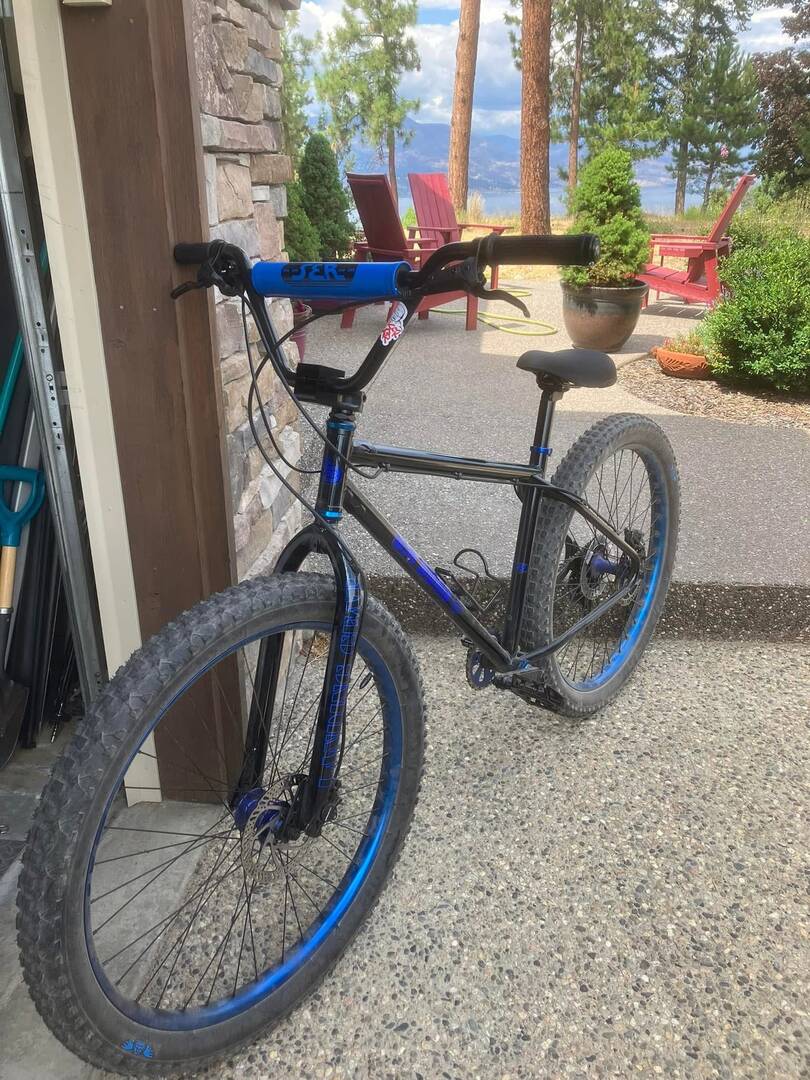
I’m certainly feeling better being more active, but I’m still carrying too much extra weight.
Big White, BC, Canada
Spent a few hours at the pump track this weekend… super fun workout!
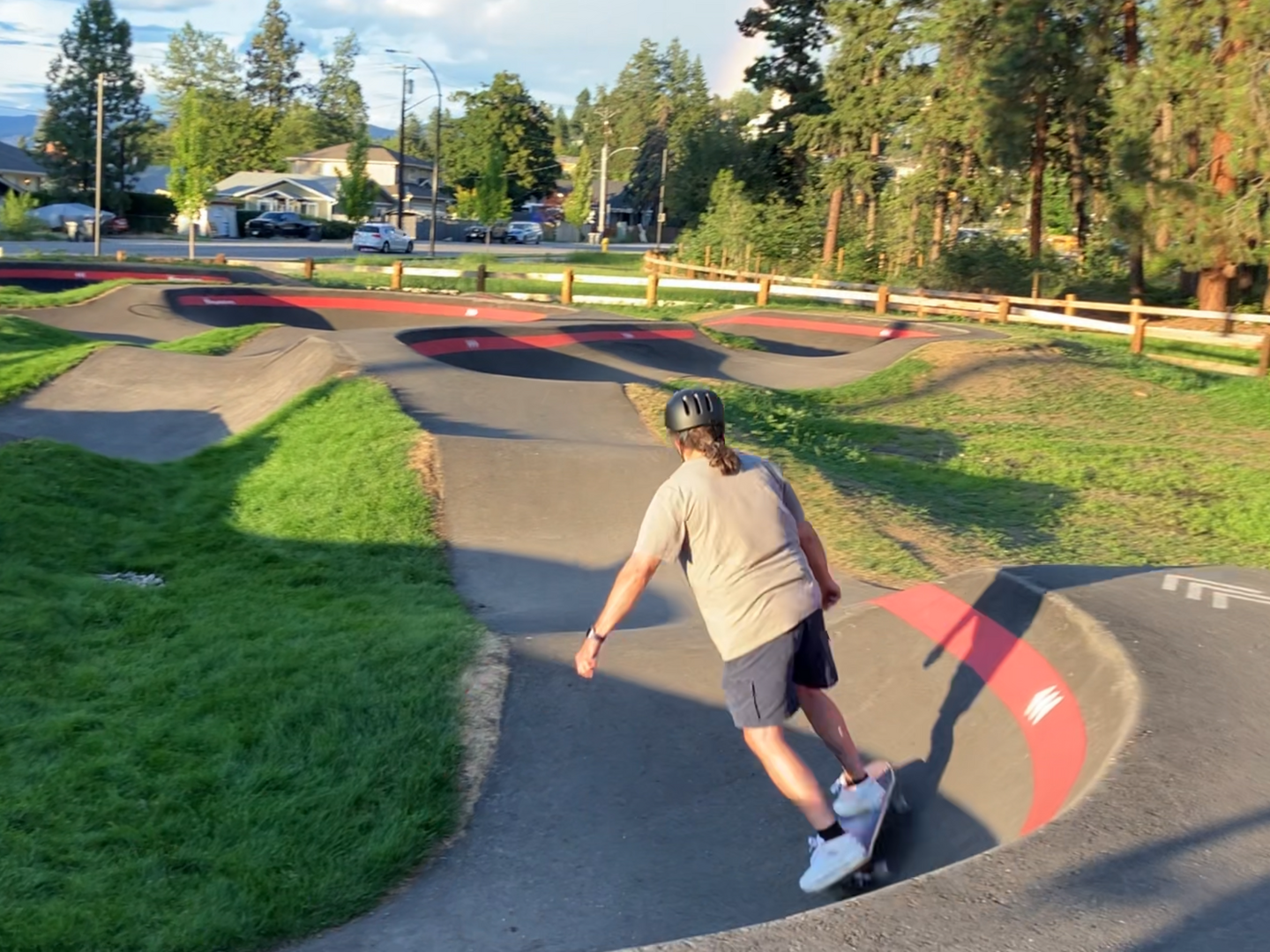
Big White, BC, Canada
I have realized how incredibly out of shape I am so not only have I been running a short 2 km loop and taking a break in the middle to do some jumps. The first few times it was my knees that complained a lot afterwards, but lately I've felt the need to find a sensible way to increase load.
I've done two jumps, 3+2 and 4+1 steps, up these stairs, about 3-4 sets of 4-6 of these "double jumps".
I tried doing the type of jump training that I'm more used to, more triple jump style except alternating each leg, but I got basically zero air and after that my knees felt... crunchy... almost as if I'd twisted them playing basketball or something... clearly not a sensible way to increase load. It's probably at least partly because I'm basically wearing a 20 kg weighted vest compared to the last time I did this type of plyo work 10 years ago...
So I've started to eat less (already like 1,5 kgs down) and yesterday I decided to dust off the old spikes to work some more on the explosive work. On the grass to reduce load/impact somewhat. 10 m standing accelerations are short enough for me to be able to do them without risking injury at higher speeds, but long enough to both work up a pulse and put some elastic strain on the old legs. A good alternative to jumping I think.
And finishing it off with 3x60 m very very relaxed sprints with just walking back as rest. I'm feeling it today, but not too bad. Considering the power I could generate in the accelerations I think it's mostly my increased weight that's holding me back, and my general complete lack of VO2 fitness.
Dreaming about soft snow
I use to love running and did long distance all through grade school. I could eat whatever I wanted (I was also young) as it burned so many calories. But I gave it up at 25 because after about 4 km my knees would be cracking with every step and really didn’t feel good afterwards. Now I’m over 50 with arthritis and really need to keep it low impact.
Weight loss is stuff… I’ve got my shoulder mostly recovered now so I’m shooting for 1 lb a week until the season starts. As much as I like to eat & drink, I like to ride more.
Big White, BC, Canada
I sprinted a bit too fast and a bit too much so my left knee started to complain so I've done some slower pace interval training, like 3-4 sets of 4 times 30 sec run 30 rest with a 5 min rest between sets, and 4x1 minute with 30 second rest too, though that one starts to resemble long distance running 🤢
I've also done some walking up my local man-made hill as low impact but high intensity training. The hill ain't much but it's honest work walking up it, about 70 vertical and 200 horizontal meters, takes me about 5 min up and <4 min down now, down several minutes from the first time! It raises the pulse a good bit! I like that it's a good mix between cardio and strength too.

I've also been re-watching Malcolm Moore's beginner and advanced snowboard tips and came across this one that I really needed with my chronically stiff ankles and achilles tendons. Especially the one where he pushes his knee over the toes.
I've been doing that stretch, a regular calf/achilles stretch using 1"x3" at the work computer, and hipflexors, hamstrings, quads and groin in front of the TV in the evening.
I've done less of the constant tension squats lately because they're so awful and draining as you do them with the light weights I have to use. I've started doing split squats instead. Also lunges and various strength, flexibility, and stability exercises over and under hurdles.
And the weightloss stuff is continuing. Down another 2.5 or so kg. What I've been trying for is to decrease my portion sizes and remember that it takes 20 min for the feeling of fullness to come and be fine with still being a little bit hungry as I stop eating with the knowledge that I will feel full soon...
Dreaming about soft snow
Lars recently posted a bunch of exercises:
But I can't see myself doing it. lol I've been stuck inside way too much over the past year and I've spent a lot of time doing physio for my shoulder... I'm just so sick of exercise for the sake of exercise at this point. Not surprisingly, the weight loss isn't going well.
Big White, BC, Canada

Yeah... home trainning does work for me neither...
