

This isn't me in the video..i'm still trying to learn and understand proper technique.
Would you agree with everything said in this video?

That’s really good!
His main points are what’s generally called angulation & inclination. I don’t know why he presented it in that order, but at the end he does say to focus on inclination (along with board/edge angle) first.
You need speed to generate G (centrifugal force), you need inclination to get your centre of mass in line with it (the bike is a good analogy), and the angulation is to balance your weight over that edge (with respect to the forces at play).
Big White, BC, Canada

I just came across this video today and it all makes perfect sense.
When he was showing clips of some of his students I could see myself in their riding.
I can leave really nice pencil lines in the snow that I am very happy and proud off, I always smile when looking at my tracks from the chairlift but... I could never get my hips close to the snow.
With his detailed explanation it made me realize what I was doing wrong. I cannot wait to get back on the slope to try some of points he brought up. At the moment this gentleman has only one video out but I for one cannot wait to see his follow up clips and information.
I still find Cherry’s simple cues to be really helpful:
1 - Dump the boots
2 - Don’t spill the drinks
But CASI & JSBA discuss inclination & angulation as well:
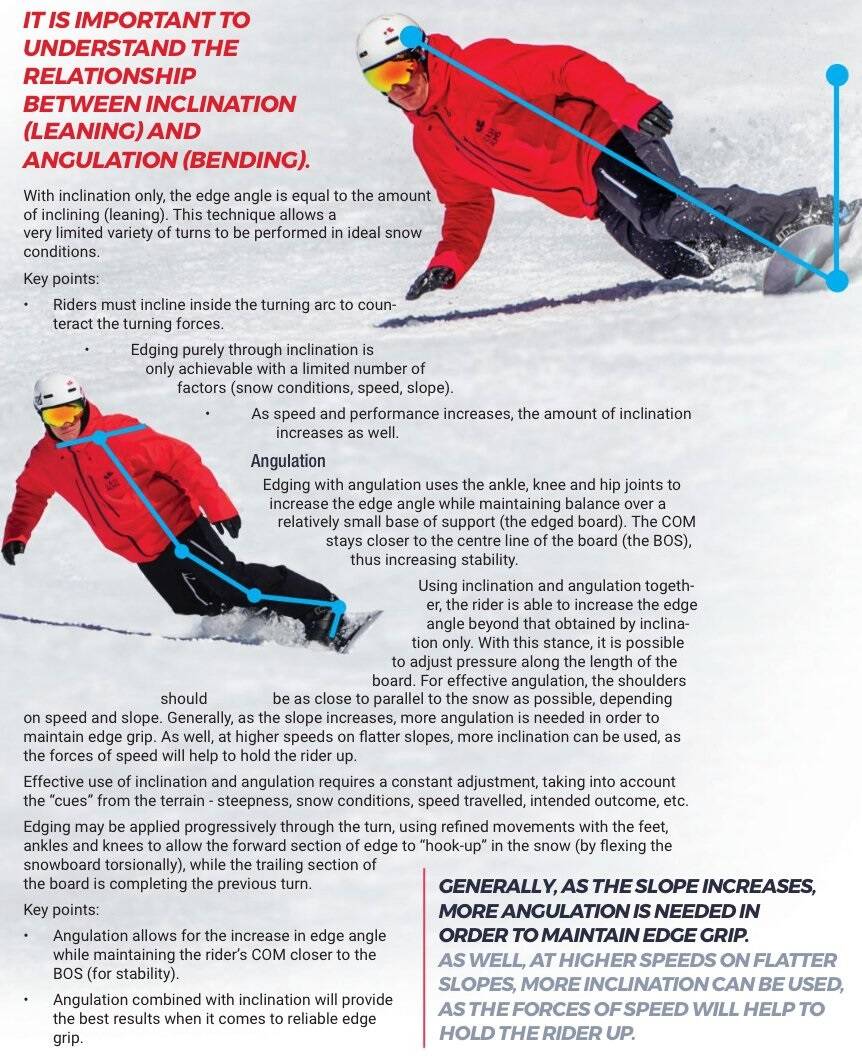
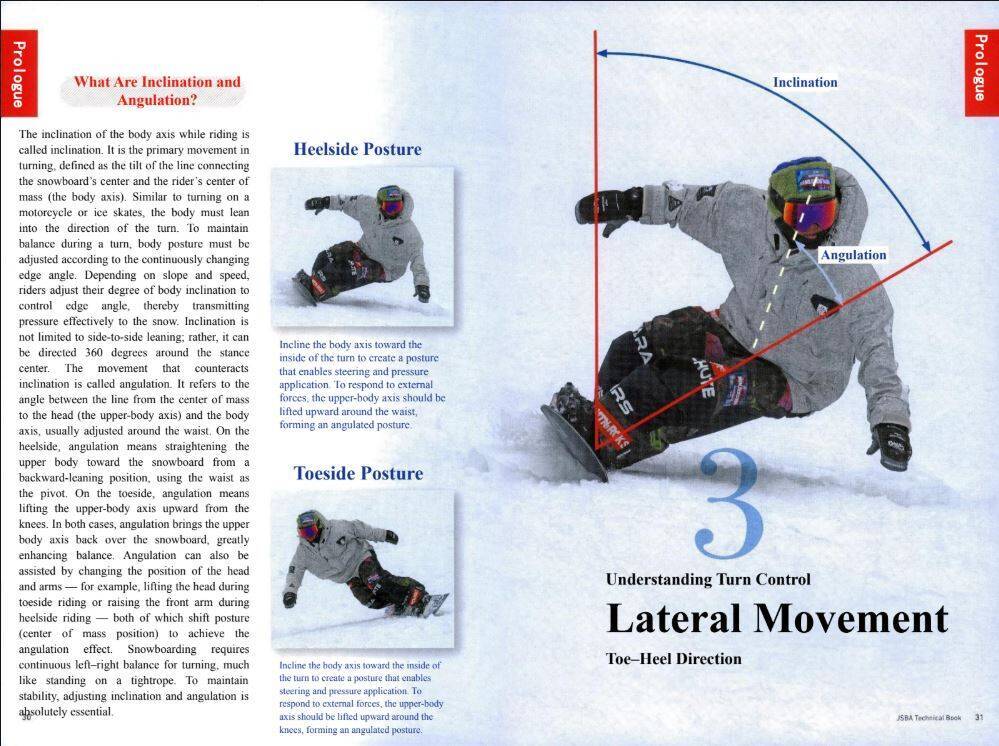
(Thanks to @pigbrogg for translating the Japanese)
Big White, BC, Canada
Here are the CASI drills to work on edging:
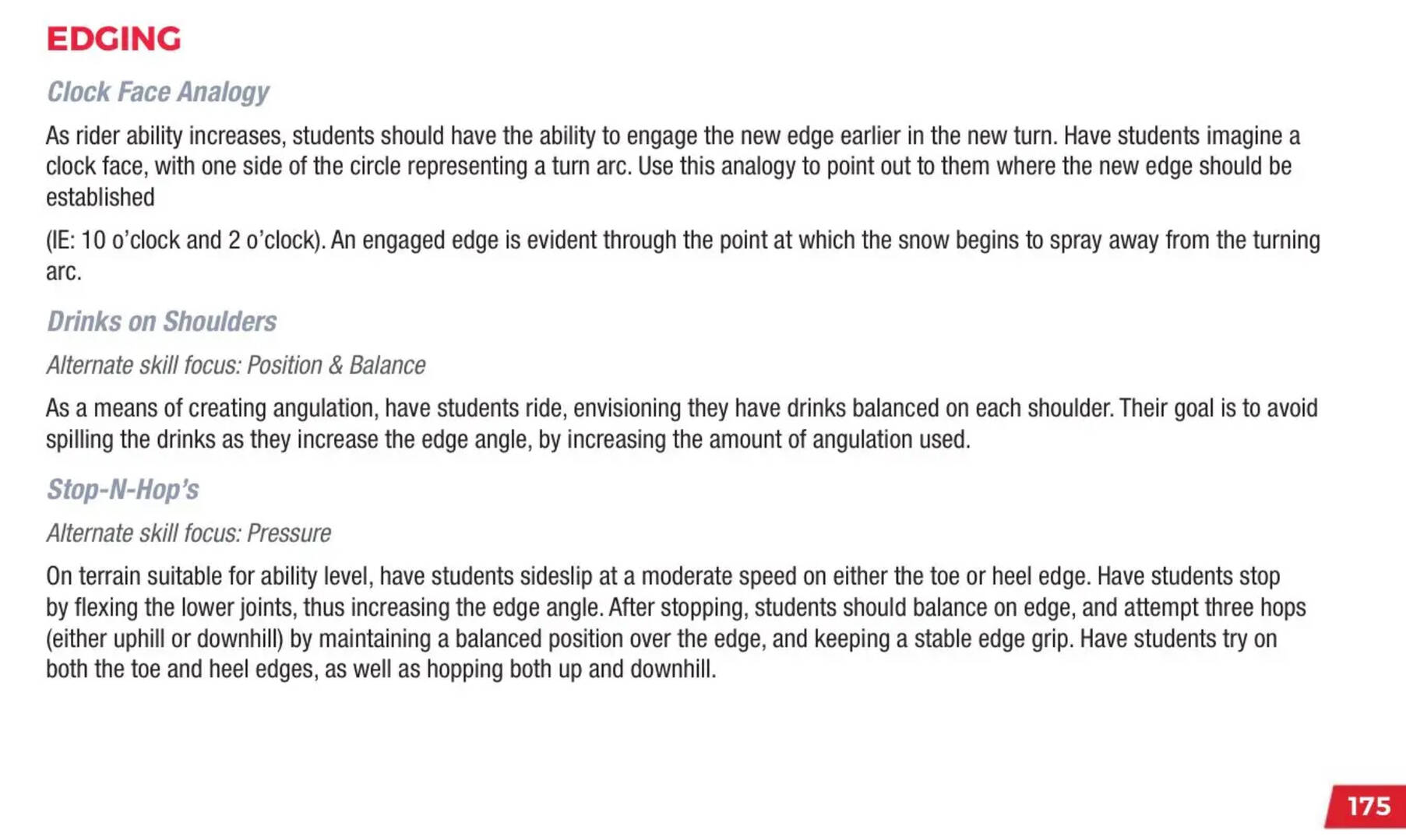
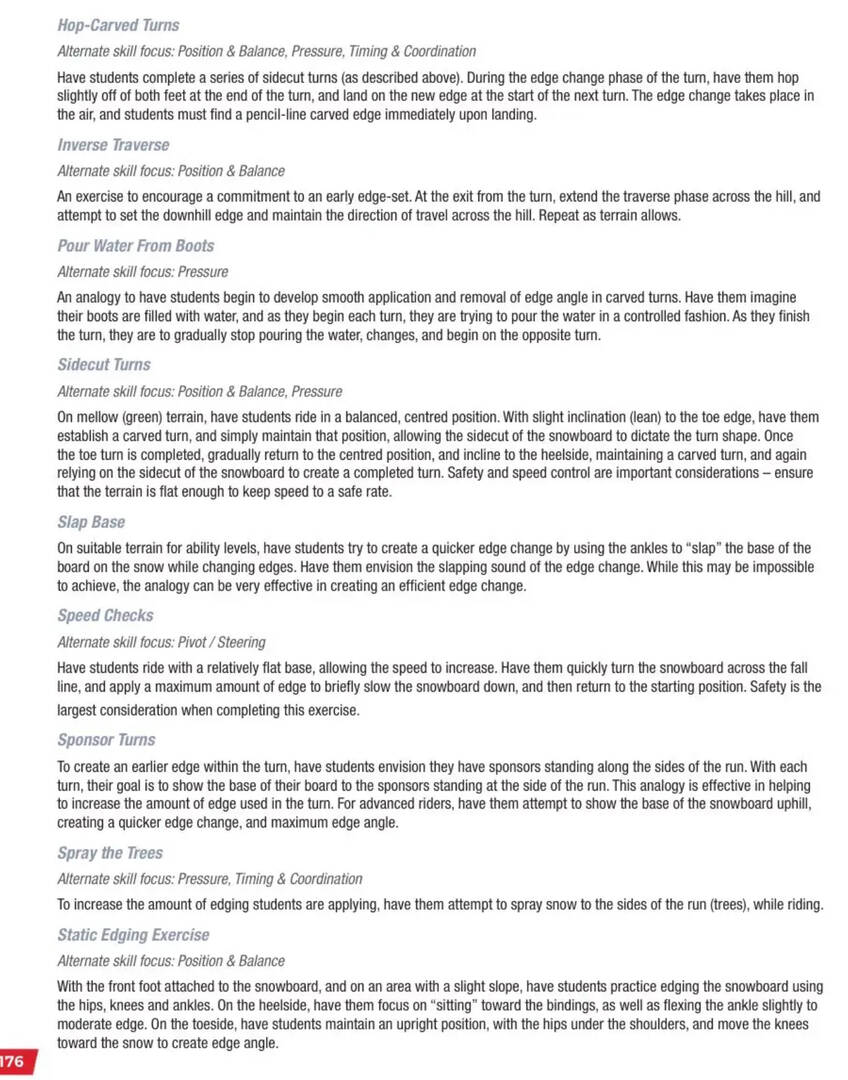
Big White, BC, Canada
I still find Cherry’s simple cues to be really helpful:
1 - Dump the boots
2 - Don’t spill the drinks
I agree with all of James tips and will keep practicing the J turns and the tray drill.
I'm just saying that what the other guy said somehow made it all clic in my pea brain. Like he said, what we are doing on the slope versus what we think we are doing can be quite different.
I think that once you get it and can actually get down, then the progress come and can discover you own and unique style.
Cheers!
Yeah I finally got an insta360 for this year and hope to improve my riding. I’ve dragged my butt on the C4 a few times, but I’d certainly like to progress further. I rode with James again at the end of last season and while he’s laying down pencil carves on the Revy steeps, I’m still using stivots & slarves to control my speed there.
I still use those two cues on a daily basis… sometimes turn-by-turn when I really need to get it together. When there’s a lot going on, these simple cues really help to guide my form and movement.
Big White, BC, Canada
His next video is up:
Certainly some interesting bits... like loose boots so that you can flex more. He seems to be coming at this from the perspective of just getting low.
Personally, I'm interested in carving better and on more terrain, getting low is really just consequence of that.
But it's good to see different perspectives.
Big White, BC, Canada
He is giving his insight in answer to what his students and others were asking for. They wanted to know how to get lower so he started this series to answer their question. He's not saying we must do that but that's how he gets down low on his heel side hand slide.
As a newbie to carving, this raises the question for me "what are the real advantages of loose versus tight boots?"
On the one side, 'tight interface'- equals more responsive to inputs
On the other side, 'loose interface' - allows our body to get into more flexible positions, perhaps a more 'surfy' feeling?
Is this a personal preference thing (ie. style/comfort preference) or is there a clear advantage to going 'as tight as possible' for the best carves (in the technical aspect)?
Definitely style, but it plays into the gear as well. There’s just no way that slop would work with a wide board, especially with boot underhang. You need that stiff interface in order to get leverage over the board.
Shockingly, Jeremy Jones runs the top of his boots loose:
But he's really an elite athlete and hardly anyone can ride like him. Even so, I’d be surprised if he was pulling the G’s that hardbooters (or even James in ‘soft’ boots) do in a carve.
For carvers that are progressing at a lower speed, some more Dorsiflexion probably would help to get low.
Big White, BC, Canada

"what are the real advantages of loose versus tight boots?"
Carving produces much more edge pressure than skidding. Your new G4 @carveaddict75 is capable of holding turns at very high pressure in comparison to your Bowlrider or your old Custom X. If your boots are loose, you have to hold/resist all those extra forces in your ankles.
So the harder, faster, steeper, and tighter that you carve the more g-force and edge pressure you produce, and the more help you're gonna want from your interface.
Hardbooters can go even faster and generate even more edge pressure than I can in my "soft" boots (thanks to @board-doctor for the air quotes), that's why they wear hard shell boots...
As an example, I put a friend of mine on a G4 last season. A competent advanced rider who had previously never been on a real carving board. One of the first things he noticed was some heel lift. This had never happened before because he was skidding around on a production board. As soon as he started to generate some real pressure, all of a sudden his usual interface was inadequate. He bought new boots the next day (and ordered a G4).
A looser interface is suitable for park riders who want to tweak their airs and freeriders who need to absorb moguls. BX riders have to navigate the whoop-do-doos at the start of the courses and some extra maneuverability is good for that too; the board can follow the terrain without the rider being tossed around as much as they might be in hard(er) boots.
For pure carving on smooth surface a stiffer interface is pretty much always better. But too stiff will limit your ability to ride off piste without getting tossed around by the board. The ability to adjust the interface stiffness to the terrain and the conditions is ideal. That means sometimes removing the boot stiffener and loosening the boas, for example.
I'm just slaying...
"what are the real advantages of loose versus tight boots?"
So the harder, faster, steeper, and tighter that you carve the more g-force and edge pressure you produce, and the more help you're gonna want from your interface.
Makes total sense. If conditions are less than ideal or if I'm not in a pure carving mood (rare lol) I can loosen everything up a bit and bring out the Bowlrider.
On fresh groom, G4 and tight all the way!
@carveaddict75 I ride the Flux CV LTD on my Stranda Shorty for a bit of a surfy feel, with Vans Verse boots. It's a really great combo.
On the C4 that's not quite enough for me though (mondo 260). CV-LTD + Insano were wicked, but those boots are just too uncomfortable for my feet. In order to wear my Verse I swapped to Rome Cleaver with the Bataleon Infinity straps... higher ankle straps and a stiffer highbacks for leverage. With my boot underhang I really don't need the reduced footprint. Both boots & bindings are kinda chunky, but they're comfy.
I also ride the C4 with more of an up-unweighted transition, whereas the Shorty can be a bit more mid/down-weighted. It seems like the Asians generally don't go much wider, they just go with steeper angles, so they don't need as much mechanical advantage over the board... and many (not all) have more of a down-unweighted style.
There's definitely some interplay between the style, equipment and terrain. Changing it up can be fun (and very humbling).
Big White, BC, Canada
@board-doctor ya i might play around with things..early season i might go a bit looser as I want to ease into things to keep things comfy while focus on the basics and get the muscle memory going again.
I suppose my interface is common (Ride Insano + Flow NX2 Carbon Fusion..and now trenched canted risers too) ...seemed to fit with my carving aspirations..i was getting numbness last year in the Insanos, but that's maybe a tradeoff if we want a tight interface.
Is it actually common to want to loosen everything before going up the lift each time?
