

Is one more 'standard technique' over the other?
When do you use each?
James' videos seem to show the Up Unweighting method, standing tall through the transition then bending and rotating to a maximum point at the apex of the turn.
So I'm curious if terrain, steepness or personal style are the main factors..

I see them as two extremes (like boundary conditions), and in reality people often use elements of each. Mid-unweighted really isn't discussed enough!
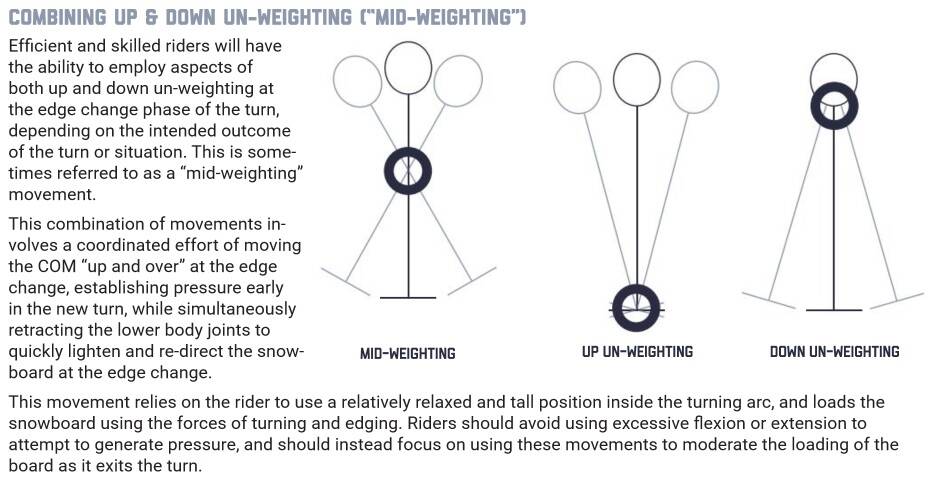
But down-unweighted is quicker as you're not moving your centre of mass, so certainly better for short/tight turns. Combined with a retraction, it can work better in variable terrain.
Up-unweighted gives you more leverage over the board and also allows you to compress and absorb some of the centrifugal force, so it's great for fast, powerful carves... but it's also good for lazy 'edge-rolls' when you're just riding the sidecut, rocking from side-to-side.
The 'norm' use to be more up-unweighted, when early boards really didn't have much torsional flex. As the industry moved to softer freestyle boards & duck stances, pedal/ankle steering (with down-unweighted turns) became more common.
Big White, BC, Canada
@jack-m has some great articles with the older terms (cross-over, cross-under & cross-through) that describe the centre-of-mass movement, rather than the unweighting, here:
http://alpinesnowboarder.com/tech-articles/
There are certainly different 'styles' as well. For down-unweighting, you've got the Korean style that's largely compressed throughout the whole turn, while the Extreme carvers do the push-pull, where they push out with inclination and pull for the unweighting. With the extreme carving, the slopes can be so steep that they don't really need much angulation to stack their weight over the edge. Sometimes Cherry gets those full extensions on the revy steeps as well (while doing more of a cross-over, up-unweighted transition).
It's odd that we have these descriptions for the transitions, but generally nothing for the turn itself.
Big White, BC, Canada

thanks @board-doctor ..the last sentence puzzles me..for example if we're trying to turn sharper, should we not be using flexion/extension in certain stages of the turn to generate more pressure on the edge of the board, thus creating a deeper bend in the sidecut and thus shorter radius? I know there's a lot of complicated physics involved (i'm not interested in that part) but I'm wondering what I should be doing with flexion/extension if I want to adjust the turn shape.
I think what they're getting at in that last bit is what James would call the patience part of the turn, followed by the finitiation. You basically "set it and forget it"... and as the turn completes, you either flex to release pressure or extend so that it'll stand you up.
Big White, BC, Canada
I'm wondering what I should be doing with flexion/extension if I want to adjust the turn shape.
I think the turn radius is largely governed by edge angle & the centrifugal force that's flexing the board. Not so much flexion/extension, which more or less modulate the pressure. For example, you can use flexion at the apex to reduce some of the pressure so that you don't overload the edge.
Initially you can weight the nose to get it bending & turning before the pressure at the apex. Towards teh end you can bring that rear knee forward to pressure the arch of your rear foot and hold the board decambered to stay in the turn... and at the end you can weight the tail to keep it bending (and not slowly releasing into a more open turn). But for a pencil carve, the tail is tracking the nose and the turn shape is largely due to the edge angle & overall flex. You can adjust the edge angle a bit during the carve.
Big White, BC, Canada

Yes, the timing of the flexion and extension depend on the rider's style but also the terrain and conditions.
Watch this video carefully, for example. The top 3/4 of this run fall away to the left creating a double fall line. So as I prepare for my toeside initiation I'm facing uphill. If I did an ordinary up-unweighted turn I might lose too much speed, so there's a tiny retraction there for quicker initiation. Whereas on heelside I'm initiating pointing more down the fall line and gaining speed so no retraction there, just a full on up-unweighted transition. This terrain rides a bit like a wave where toesides are top turns and heelsides are bottom turns.
https://youtube.com/shorts/2h6dr_f7Vgo?feature=share
Watch this one too. At the slow-mo toeside just in front of the camera there's a roller, so again, I have to initiate heading a bit uphill. I always do a retraction here or else I can't maintain enough speed for a smooth initiation as I ride up the roller. The next heelside I also do a small retraction because there's not much room for a slower, wider initiation.
https://youtube.com/shorts/vIrqfepL7Zo?si=uuasYpGW6Q24kogP
The retraction (or down unweighed transition) will help you initiate and get on edge quicker, resulting in a tighter radius carve. But it also slows you down and reduces g-force, and lends itself to a low body position with the body dragging on the snow. So it's good to have this option in the toolbox, but wherever possible I prefer to remain tall in the transition and avoid any retraction for smoother, faster and wider turns, and more g-force. This is purely a personal style preference; lots of riders retract on every turn.
I'm just slaying...
Thanks @wild-cherry I'll be watching them 50 times like I do all your other videos to learn as much as I can!
