

New here—intermediate rider, beginner carver.
6'4", 200–205 lb, 50 y/o • Size 12 (Mondo 30) Ride Insano boots
Coming off a Burton Custom X 162W → now (just purchased) Stranda Bowlrider 2.0 165W
Home hill: Whistler
Long term I realize I may need wider for higher edge angles, but hoping the Bowlrider is a solid step while I progress.
A few questions:
-
Bindings (Flow NX2 Carbon): Solid choice?.. but no high-back rotation—should I care for carving, or is the fit/stance more important?
-
Posi-posi & canting: I’ve watched James’ vids; canting makes sense biomechanically. Flows list ~2.5° (or mm?) of cant. Any cheap ways to test more cant (shims/spacers) before I commit? Worth experimenting by slightly lifting toes (front foot) and heel (back foot) via in-boot/insole stack to help hip position? Hip mobility isn’t what it used to be, so I’m chasing every small advantage.
-
Risers: To hit big edge angles (aiming for James/Lars territory), do I need risers? Before I jump to a ~30 cm waist, are Trenched-style risers a “no-brainer” to try first?
-
Coach recs: Anyone Whistler-area teaching James/Lars-style carving? I can drive to Fernie if needed, but local sessions spaced over a few weeks would be ideal.
Thanks!

You're not even in the ballpark, sorry... That 165 W Bowlrider is only 27 at the waist. I might be able to make it work on low angle terrain with my 26.5 boots but at Mondo 30 you're gonna have massive overhang. Risers can help, yes, but your carving progression will be limited for sure.
Riders your size are not well served by the industry, particularly if you want to carve hard. That's just the way it is man. That's partly why I started pushing small builders to make wider boards! (And I don't even have big feet!)
To your specific questions:
1. I don't find that highback rotation is necessary on the NX2. They have the cable down the side and a good curvature to the highback. Rotatable would probably be better, but it's not essential. With your big feet and small board, any benefit of a rotatable highback would be completely wiped out by the added length of the heelcup. I don't usually recommend the Carbon version because the regular is plenty stiff, but you're 40lbs heavier than me so go for it! Make sure it's the Fusion, not the Hybrid straps.
2. The steeper your angles, the more you need lift over cant. The canting in the Flows is great, but it's designed for more common duck stances. It's plenty of canting, you don't need more. Definitely experiment with heel and toe lift or buy the Trenched Canted Risers. This is a game changer for riders with tight hips, and you're going to have to go to quite steep angles with those flippers of yours.
3. The Canted Risers are great but they're not going to magically eliminate your boot drag. A wider board will be essential for high edge angles.
4. There is a serious lack of qualified posi-posi carving instructors. I do know one CASI instructor in your area that can probably help. He's in hard boots but the technique is almost identical. Send me a PM and I'll forward his number.
I'm just slaying...
@wild-cherry Thanks James. I'm learning as much as I can on the subject. Just curious what your thoughts are on this video
as he seems to say on size 12 boots on a board with 25.1cm waist that you can still get really good angles? Would you disagree with some of the stuff he's saying.. Just curious, and if so, why?
Yeah man, this is exactly the kind of industry BS that I've been railing against for years...
I watched the video, and even took notes... I've seen this one come up before because "Wide Boards" is in the title but I had never watched it.
Let's start with the ad hominem rebuttals first shall we?
-Peter Glen is a chain of board shop based in Florida. Their northernmost location is in Georgia. The guy in this video probably rides two weeks per season on a family trip to Colorado.
-Peter Glen sells snowboards. So of course they're not going to tell you to go to a custom builder for a specialty board, they want to sell you whatever is on the shelf in their inventory. So when he says at 5:30 "Size 12 is the tipping point where you don't need a wide board" he's grouping in 99% of population who wear size 12 or smaller.
-This guy says at 11:30 "I can lay down a carve on a snowboard" but then the video plays and he's not carving, he's traversing a flat area... His other carving in the video is not much better; he's not even closing his turns and these are about as flat as runs get.
-This video hasn't aged well. At 14:30 he says "A lot of the information on the internet is outdated". He couldn't be more wrong. The trend from 2000-2010 was shorter and smaller boards, but the trend from 2015 to 2025 is wider. More and more companies are making wider boards, Stranda jumped a whole cm up for the Cheater this season, from 275 to 285!
-I will give him credit for one thing: at 12:53 he says something like "If you're an advanced rider who carves hard, this video doesn't apply to you". That is most certainly true, though I would have phrased it differently: "If you aspire to carve your snowboard on anything steeper than the easiest green runs, and control your speed with turn shape only, you're watching the wrong video."
Now the technical errors:
-He tips the board up on a hard flat surface and claims that you can up to 45 degrees of edge angle before your boots hit. He's forgetting that the board sinks into the snow also... My trenches are 2-3"deep on average, I need some room there. Tipping the board up is not a good way to estimate drag, putting a carpenter's square on the floor and sliding it up to your board's edge is the way to measure overhang/underhang and estimate drag.
-Some drag is normal and acceptable. But when your toes start to push into the surface, that takes pressure off the edge and physically levers your board out of the trench.
-This dude is suggesting that the width of the board is independent of the rider's boot size. So a size 25 can or should ride the same width as a size 30 boot? Ridiculous.
-Somewhere later in the video he addresses the issue of riding steep runs and says that it's only a problem when you're traversing across the run. This is not untrue, but this exactly why extreme freeriders also need wider boards. Because they are traversing straight across icy slopes to get to the pow pocket or their drop in and if their toes hit the snow they will lose the edge, sometimes with high consequences.
-These production boards are not designed for high edge angles. So even if you didn't have overhang, these glass boards won't hold the edge pressure above 60 degrees anyway. This is why they have 8m sidecuts, so you don't need that high edge angle to turn tight. Where's the fun in that???
-There are many reasons why the industry doesn't make super wide boards. First, they would have to re-tool their presses and grinders. Second, when you build with tri-ax glass you run into limits where performance is lost as the boards get wide because the torsional pressure gets very high (enter Titanal contruction and the small custom builders who have solved this problem). Third, no one want to be first and take the risk, so all the companies are slowly creeping up a little more each season (props to NeverSummer to being the first to go all the way up to 284 about five years ago and still making the widest production boards in the industry). They want you to believe that foot size has nothing to do with board width, and you should select your board size based on your height, weight, and skill level only, like a surfboard.
My own experience:
-An intermediate carver can get away with a hair of overhang on hard snow. An expert carver cannot.
-My happy width is in the 295-300 range, 30-35mm larger than my Mondo boot size. I still drag but it's not catastrophic. Testing the G4 prototypes last season I had a batch in the 162 size with 286mm waists. I could carve these as hard as I want, until it got steep. I had a few catastrophic boot out episodes (when I boot out on heelside and the rotational momentum spins me to my back so I'm sliding down completely out of control head first on my back and I can't even dig my whole edge in to slow down because my bindings are overhanging and guess what? In this position my edge angles is 90 degrees...). Now I get all my prototypes in larger sizes so there are no terrain limits and I can enjoy my work. What I'm saying is, 21mm in the waist longer than my boot size was insufficient for the kind of carving I want to do (note that I had these 162s at 30/18 stance angles and Canted Risers too).
-The steeper the runs you carve, the more width you need. The softer the snow surface, the more width you need. The faster you want to carve, the more width you need. The longer your sidecut, the more width you need. The stiffer the board, the more width you need... The G4 162s with 286 waist x 11m radius was too narrow for steep runs, but my NeverSummer 284 waist x 8m can manage it (sort of - boot drag is not the issue here, board performance and limitations of the materials are the limiting factors when it gets steep).
-If you want to carve fast and steep, no overhang is acceptable. Some underhang is recommended at the expert level, particularly on soft snow.
-I get my board up to 80 degrees quite often, and i dig deep trenches. This would not possible with overhang.
-Some drag will always be present. My first wide board was a Donek with a 31cm waist (12m sidecut). I could boot that out too when I tried hard, and it was cumbersome, too wide. There is no magic number at which you completely eliminate any boot drag. There's always going to be a tradeoff.
In summary @carveaddict75, that video is BS industry propaganda.
Keep that Bowlrider until boot drag becomes a problem (at the advanced intermediate level I would estimate) and then risers can help, but eventually you're gonna want a wide board with a longer sidecut. If you can afford it, just get it now. A Big Snowboards G4 and some sessions with Boris will speed you through the learning curve. People sometimes think that they're not ready for a board like this but the truth is that it's going to way harder to carve that Bowlrider, more physically and more technically demanding.
I'm just slaying...
Thanks again James for sharing your wealth of knowledge.
I've heard people saying that if your boots are more narrow than the board, the board is exerting more force over the rider than the rider over the board. Is that overcome with strength and technique? In my mind I think I would need to 'tilt more' or exert more force if the pressure exerted on the board is a bit further from the edge? Lars had a good demonstration of this in one of his videos. Seems what you're saying is that a wider board will still offer greater advantages even if the above points are true? If getting lessons and hitting the gym will speed my progression, I'm game!
Is there any place I can demo a wide board like you suggest, this season? I have a long ways to go in terms of progression but if you're saying it's better to go wide now to accelerate my progression, I'd like to give it a shot this year and perhaps get into a new board for later this season or early next season

boots are more narrow than the board, the board is exerting more force over the rider than the rider over the board
I think that’s overstating things, but it’s true in general. I think Lars reasoning is sound overall, but his demo with blocks of wood is very flawed. Also, when he’s talking to people he’s doing it from his perspective, which is one of being fine with some amount of booting out and to some extent modifying his riding to not boot out to get a more agile board. Compared this to James who is completely not fine with occasionally booting out because he has a very specific vision with how he wants to ride. So they’re coming at the way they ride and select boards from very different points of view and you have to take this into account when listening to their advice
But yes, a wider board will be more difficult to tip on edge. But something I don’t hear being mentioned in these discussions is that a softer interface (boots and bindings) will also make a board more difficult to tip on edge because some of the force you try to put into the board just goes into flexing your interface rather than tipping your board on edge.
PS. I’m a mediocre rider who’s got some underhand on my Stranda Shorty (millimeters) but I still find it easier to ride than most, if not all, the rental boards (mostly twins) I’ve been put on where I had boot overhang. And that’s because of the board design and characteristics.
And regardless, the Bowlrider will be an awesome, nimble, allmountain board for you. I had such difficulty choosing between then original and the Shorty last year. And it clearly will carve, just not as hard as something designed for carving rather than versatility
Dreaming about soft snow
@superfelix Thanks for chiming in. I appreciate there are so many nuances and differing points of view, and like so many things in life, there's no 'one size fits all'.
My thoughts..At worst, the bowlrider will be a great board to progress in the interim as I build my strength and technique. Likely I'll KNOW when I need something much wider...or will I... lol

@carveaddict75 Great topic for us underserved bigger riders😎 I’m 65 @225lbs and started to focus on carving 7 years ago when I got a custom Donek Flux with a 281 waist, that was after 20 years of powder hounding. I’ve always ridden bigger boards with risers and “step in” bindings. I have size 12US boots (K2 Thraxis) and Flow NX2 Carbon bindings now - the stiffest set up I know of and then add James’ Trenched boot stiffeners and Trenched boot straps too.
Even with risers on my OG Donek I had to increase binding angles as I got better with carving. For the past 3 seasons my angels have been F39/R30 to avoid boot out issues. This is a bigger issue the faster you are going at the apex of the turn - consequences can be hurtful.
I bought a Strada Cheater 170w and a Pipeline 2.0, both with 275 waists, and they are the narrowest carving boards I have. They have a wonderful, playful feel when I,m not at the limit (which is most of the time😎). They work with my set up and skill level - but they don’t give me zero toe drag. But when conditions are very firm and fast and I’m being very aggressive at high edge angles - they just don’t have the torsional stiffness to hold the edge and will skid and chatter.
I was one one the first 30 who bought the awesome JJA C4 166 from James - and that board is a serious carving machine - way better edge grip and more damped torsional stiffness pulling high-g’s. It’s more demanding on turn initiation but can power hold the edge until the snow gives way. This is the board that will always be way better than me - so I’m thrilled I got it when I did.
Enjoy all your turns this season - I know I will. If you’re even in Colorado this season let me know and I’ll take you rinding on my mountain - Loveland Basin & Valley
@carveaddict75carveaddict75 some Board Porn😎😎😎
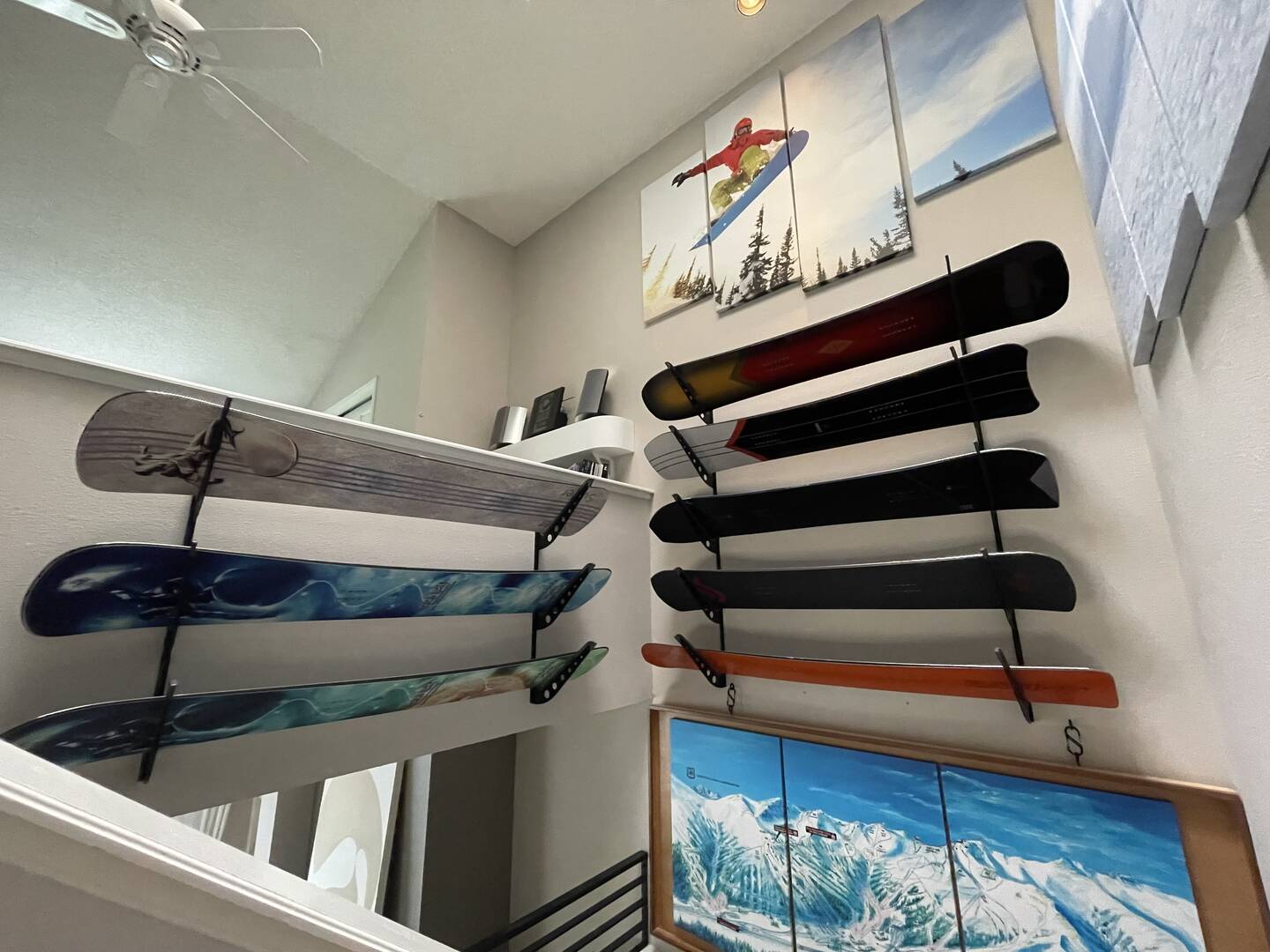
Is there any place I can demo a wide board like you suggest, this season?
Yes! Revelstoke (or at the Montucky Clear Cut).
But something I don’t hear being mentioned in these discussions is that a softer interface (boots and bindings) will also make a board more difficult to tip on edge
Very true!
JJA C4 166 from James - and that board is a serious carving machine -
Also very true hahaha...
@rocketman69 You got one of the only two real Stiff Flex C4s. After that first batch we toned down the stiffness about 6% on all the flexes.
I'm just slaying...
@wild-cherry Yes indeed I do - I hope to ride it hard for the next 5 seasons - hahaha
But seriously - with all my boards, the C4 comes up to the mountain as my second board almost every time. If the groomers are super firm - I'll strap the C4 on and let it eat 😎 I'm hoping some early season man-made will give me that nice firm groom to slice up 😛 😛 😛
Thank you for making this amazing board available to those who are still not deserving - and thank you for all that you are doing to foster growth in the carving market and keeping JJA busy making his awesome contribution to the softboot carving community!!!

Last year was my first season on a C4. To those who worry about getting a wider board up on edge, I’d suggest it only takes a run or two to get used to it. What does take a bit of time to get used to is how well it carves (building up trust to commit to turns you’ve never been able to do before).
Dan
@danielgrow @wild-cherry Curious if having big feet (my size 12's, 30 Mondo boots) somewhat offsets edge-to-edge/transition difficulty since I've got more leverage applied to edge of board?
Curious on others' thoughts too who are in a similar place as me (aspiring carver, upgrading my gear), if it really was a 'night and day' difference once you went with 30+cm waist, and if it was actually 'confidence inspiring'? I find myself needing to scrub turns to control speed, especially on anything steeper than Greens.
If I can improve my carving technique, hopefully I'll get to a point where I can control speed through 'turn shape' as Lars from Justaride describes, and aside from technique sounds like the equipment used might be the other major limiting factor.
Curious if having big feet (my size 12's, 30 Mondo boots) somewhat offsets edge-to-edge/transition difficulty since I've got more leverage applied to edge of board?
Definitely yes. It won't feel as wide and cumbersome to you, it's your size.
aside from technique sounds like the equipment used might be the other major limiting factor.
It's gonna be tough to get high edge angles and carve a deep trench if your boots are overhanging.
And when I say tough I mean just about impossible... With a down unweighted technique and risers you can sneak a few extra degrees but you're not truly controlling speed with turn shape, down unweighting slows you down and reduces g-force.
I'm just slaying...

With a down unweighted technique and risers you can sneak a few extra degrees but you're not truly controlling speed with turn shape, down unweighting slows you down and reduces g-force.
I've heard others say similar things and I'm still trying to wrap my brain around it. I don't think the unweighted transition really changes much, but if there's extension through the turn it'll add force (rather than absorb it). The pressure naturally builds through the turn and this additional extension force can overload it. So there's actually more force on the edge, and if your trench doesn't support that you'll skid rather than continue your angular acceleration (turn). So yeah, the edge can only support so much and if you're adding force through extension, this will reduce the amount of G-force it'll sustain.
But how how does this affect heel/toe drag? The only way I see this is if you're not completing your turns (and building more edge angle in the turn).
Big White, BC, Canada
